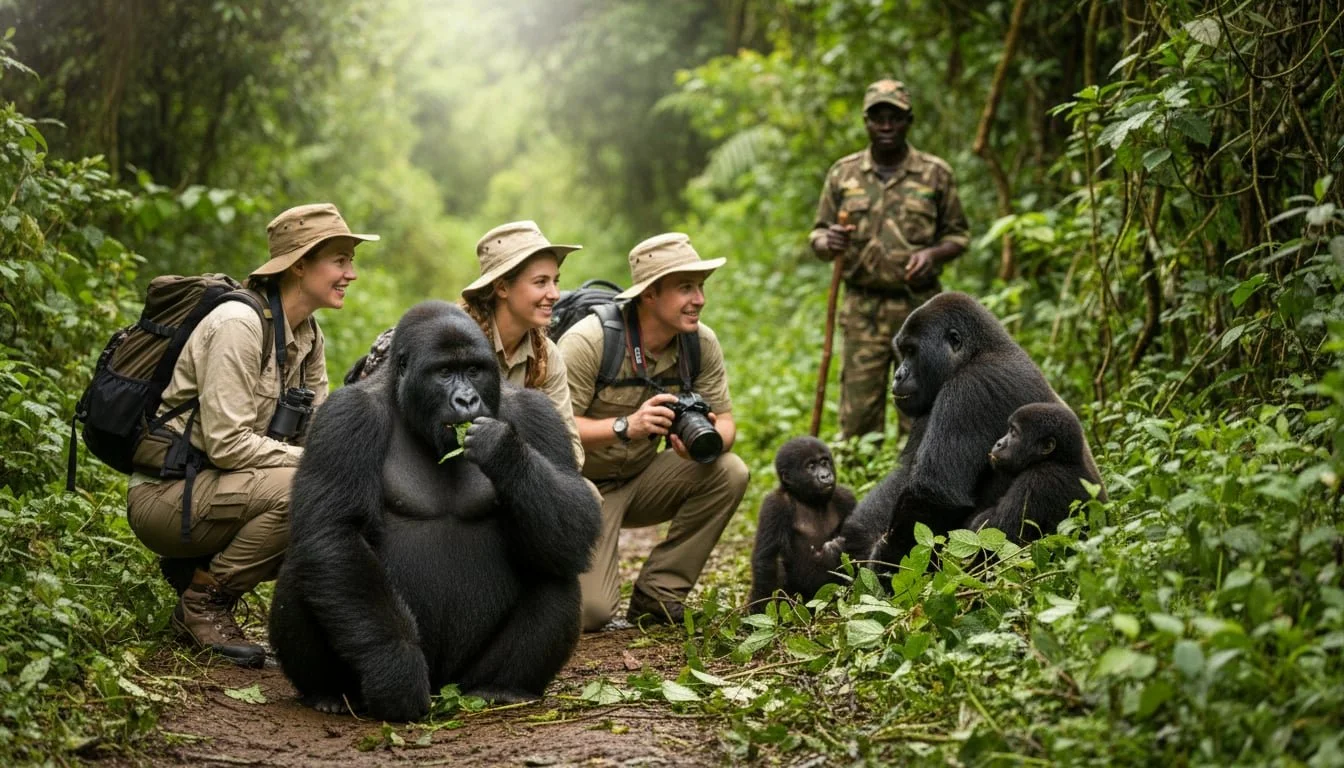
Gorilla Habituation Experience in Uganda
Venture deeper into Bwindi Impenetrable National Park for an extraordinary Gorilla Habituation Experience in Uganda, with the opportunity to spend up to four hours observing mountain gorillas alongside professional trackers, researchers and habituation teams.
The Gorilla Habituation Experience in Uganda is one of the most extraordinary wildlife encounters available anywhere in Africa. Unlike a standard gorilla trekking experience, where visitors spend up to one hour observing a fully habituated mountain gorilla family, gorilla habituation gives travelers significantly more time in the forest and up to four hours in the presence of a gorilla family undergoing the gradual habituation process. It is an immersive experience designed for travelers who want to go beyond simply seeing mountain gorillas and gain a deeper understanding of their behavior, social interactions, feeding patterns, movements, and relationship with the forest.
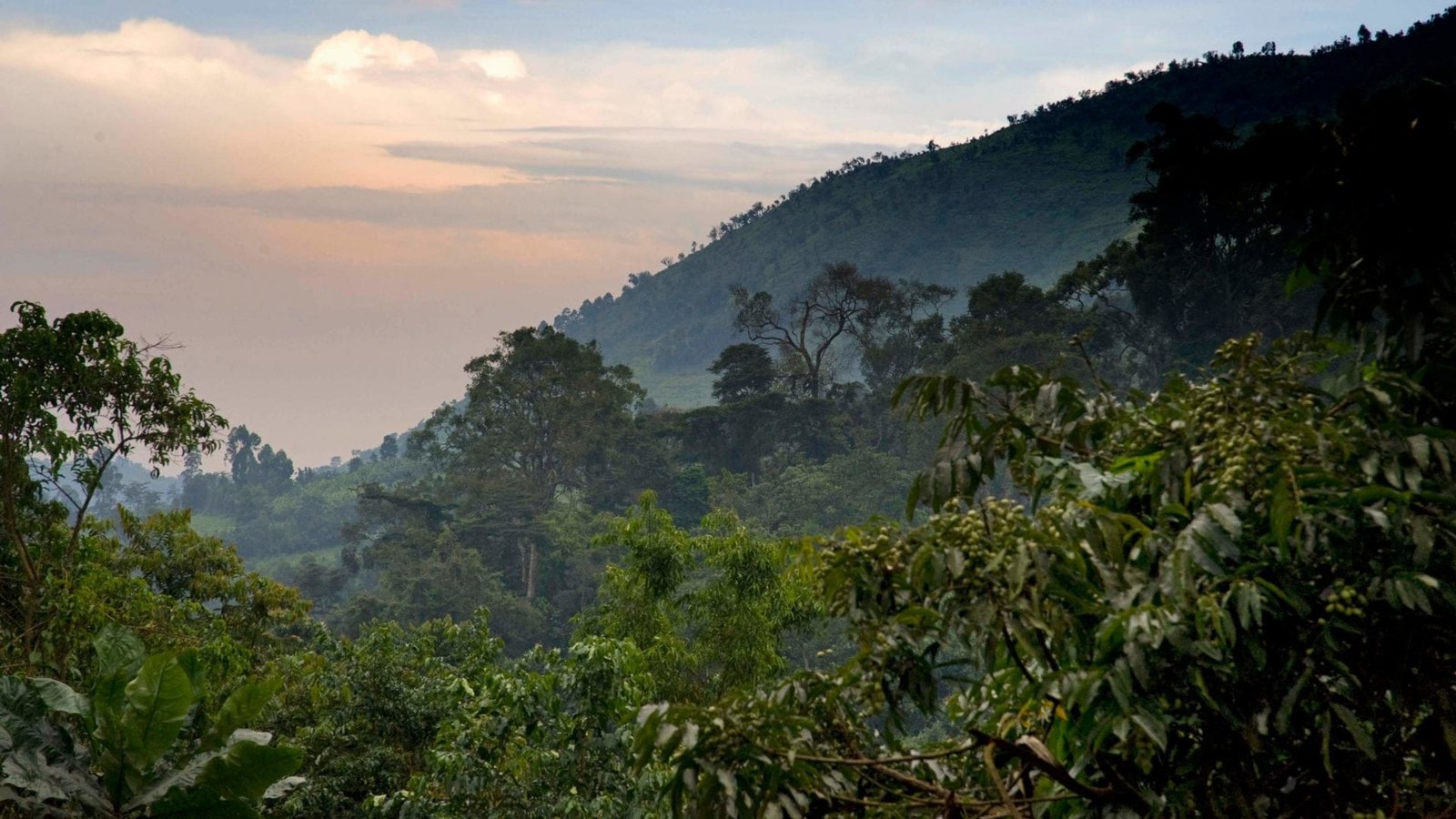
Uganda is currently the leading destination for travelers seeking this specialized primate adventure. The experience takes place in Bwindi Impenetrable National Park, one of Africa’s most biologically diverse tropical forests and one of the most important remaining habitats for endangered mountain gorillas. The thick vegetation, mist-covered hills, ancient trees, deep valleys, birdlife, butterflies, and primates make the journey through Bwindi just as memorable as the time spent with the gorillas themselves.
A Gorilla Habituation Experience in Uganda is particularly suitable for photographers, wildlife enthusiasts, researchers at heart, returning gorilla trekkers, and travelers who simply want more meaningful time with mountain gorillas. The extended encounter creates opportunities to observe details that can easily be missed during a conventional one-hour trek. You may watch a silverback monitoring his family, juveniles playing among the vegetation, mothers caring for their young, or gorillas quietly feeding while researchers and trackers continue helping them become accustomed to controlled human presence.
At Nextgen Safaris, we arrange customized Gorilla Habituation Experience safaris in Uganda for solo travelers, couples, families, photographers, private groups, and luxury travelers. A habituation safari can be organized as a short trip from Kigali or Entebbe, or incorporated into a longer Uganda safari featuring chimpanzee trekking, Queen Elizabeth National Park, Lake Bunyonyi, Lake Mburo National Park, Murchison Falls National Park, or other remarkable destinations across the country.
What Is the Gorilla Habituation Experience in Uganda?
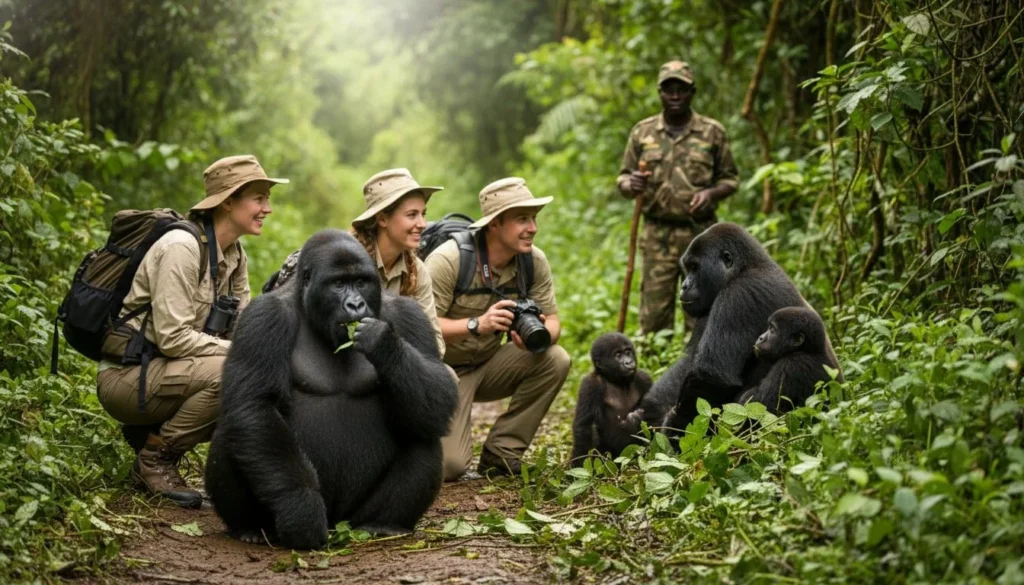
The Gorilla Habituation Experience in Uganda is a specialized wildlife activity that allows a small number of visitors to accompany experienced trackers, researchers, conservation personnel, and guides as they follow a mountain gorilla family that is still becoming accustomed to the presence of humans. Gorilla habituation itself is a gradual process that can take several years because wild gorillas must slowly learn that the controlled presence of researchers, trackers, guides, and eventually tourists does not represent a threat.
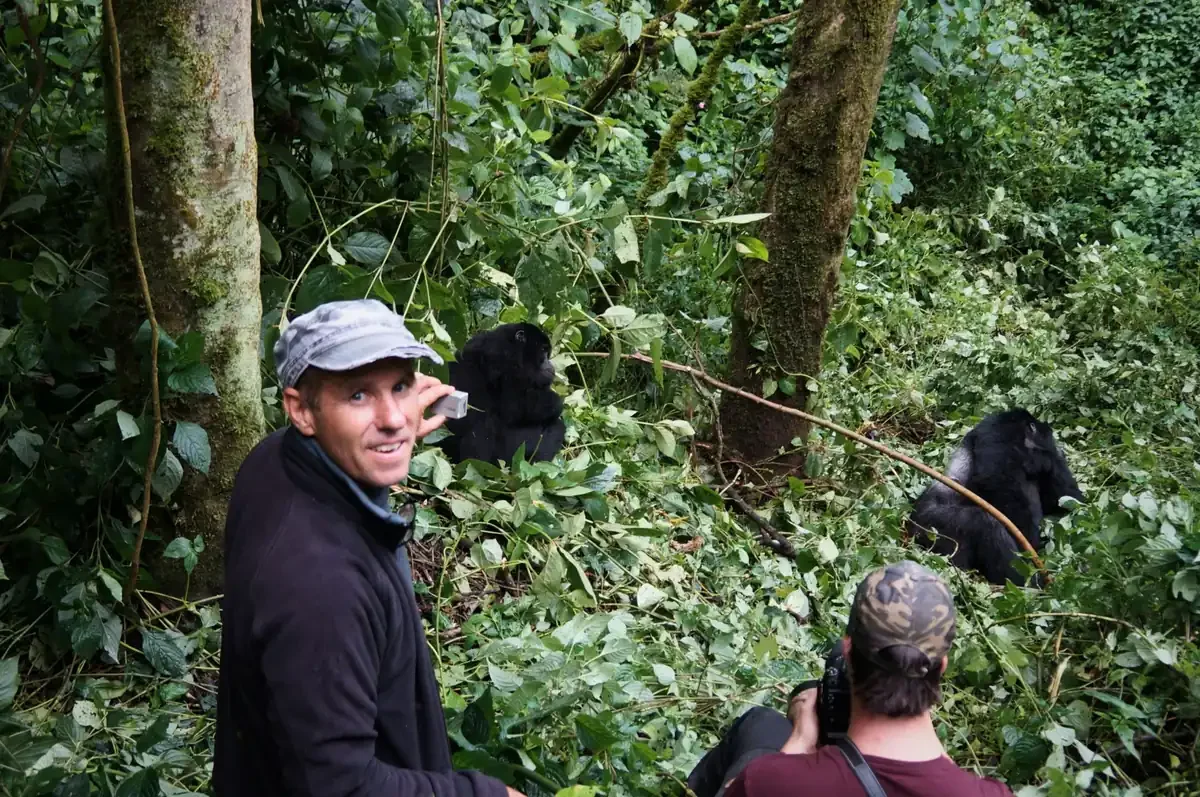
During the experience, visitors enter Bwindi Impenetrable Forest early in the morning after a briefing from the responsible wildlife authorities. The trek can involve walking through thick rainforest, climbing steep slopes, crossing small streams, and following narrow forest trails while trackers search for the gorilla family. The length of the walk varies because mountain gorillas move freely within their natural habitat and their location is never completely predictable.
Once the gorillas are located and the appropriate viewing period begins, visitors can spend considerably longer observing them than during a standard gorilla trek. This extended time is what makes the experience so appealing. Instead of feeling that the encounter has only just begun before it is time to leave, travelers have the opportunity to settle into the rhythm of the gorilla family and observe natural behavior over a longer period.
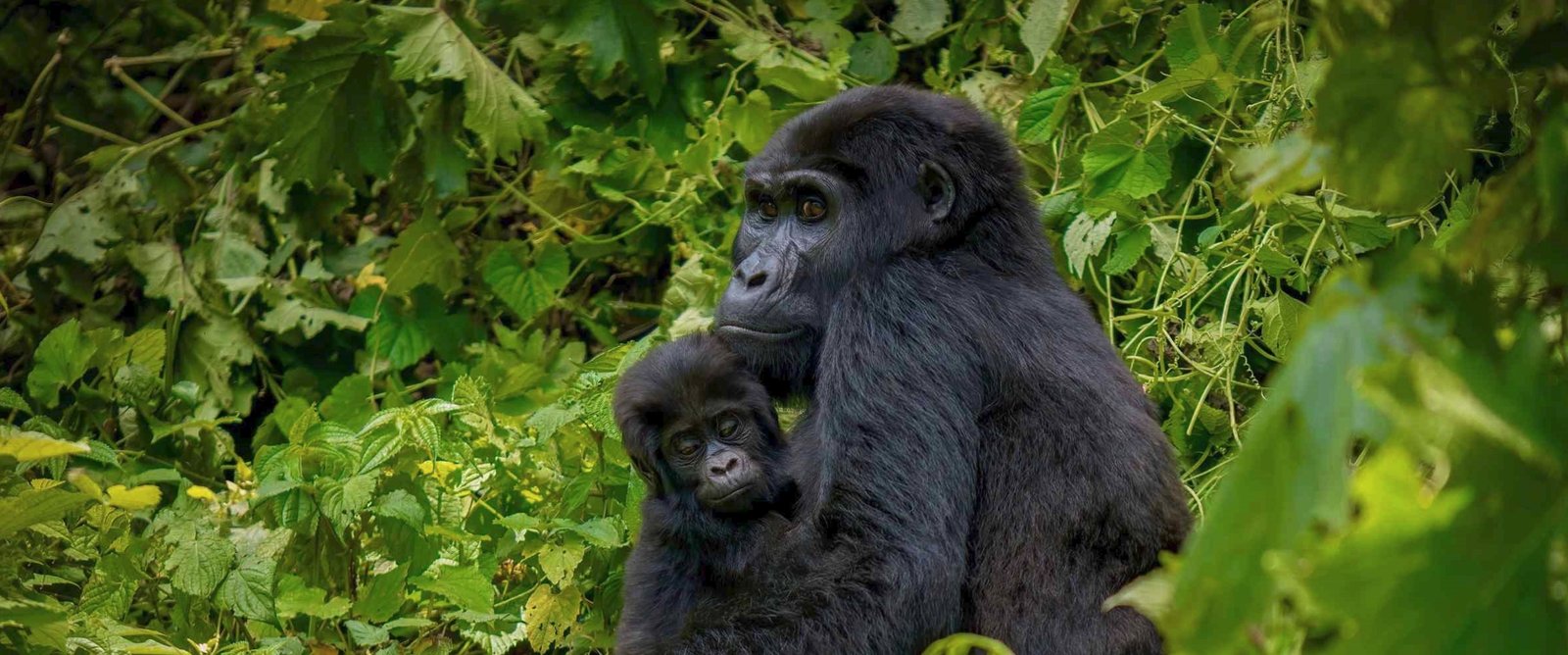
You may see gorillas feeding on leaves, shoots and other forest vegetation, resting beneath the canopy, grooming one another, climbing trees, communicating through vocalizations, or moving deeper into the forest. Young gorillas may play, chase each other or interact curiously with their surroundings, while the dominant silverback often remains attentive to the movements and safety of the group.
The experience is still carefully controlled. Visitors must follow instructions from guides and conservation personnel, maintain the required distance whenever possible, avoid unnecessary noise, and respect all rules designed to protect both the gorillas and the people visiting them. These guidelines are particularly important because mountain gorillas share many biological similarities with humans and can be vulnerable to human illnesses.
For travelers who want a deeper and more educational primate experience, the Gorilla Habituation Experience in Uganda offers something genuinely different from ordinary wildlife viewing. It combines adventure, conservation, observation and photography within one of Africa’s most spectacular rainforest environments. Rather than simply ticking gorillas off a wildlife checklist, visitors gain an opportunity to understand the patience and conservation work required before a wild gorilla family can safely receive regular tourist visits.
This makes gorilla habituation one of the most exclusive and rewarding experiences to include in a Uganda safari.
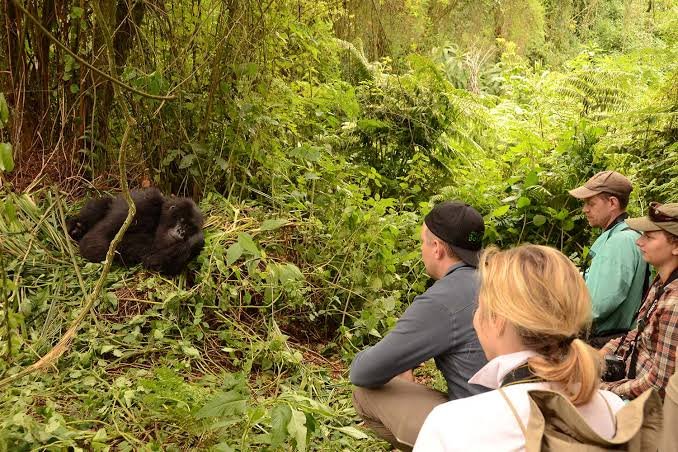
Gorilla Habituation Experience
Spend extended time observing mountain gorillas in the forests of Bwindi Impenetrable National Park.
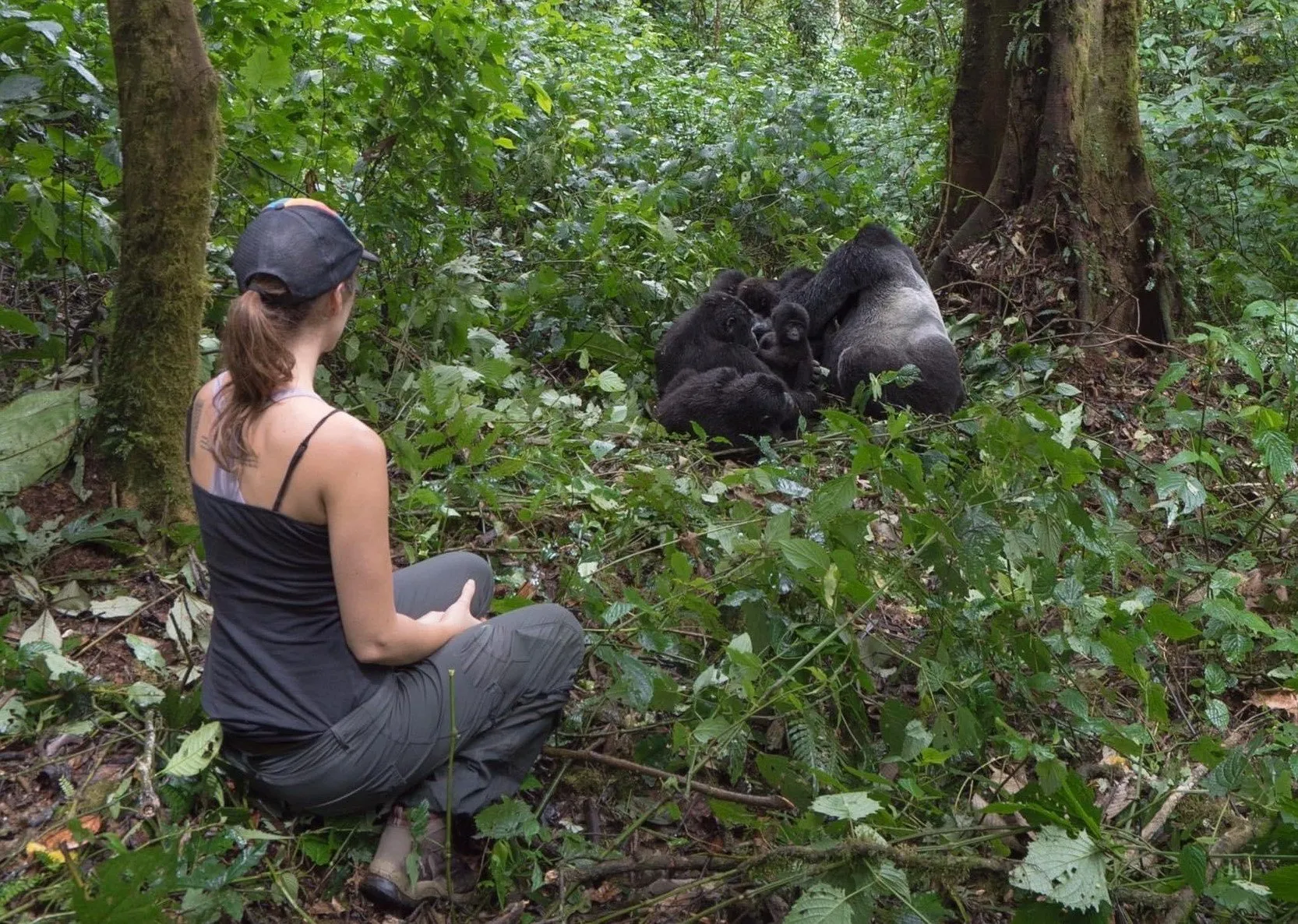
Gorilla Trekking in Uganda
Trek through Bwindi’s rainforest for an unforgettable encounter with mountain gorillas in their natural habitat.
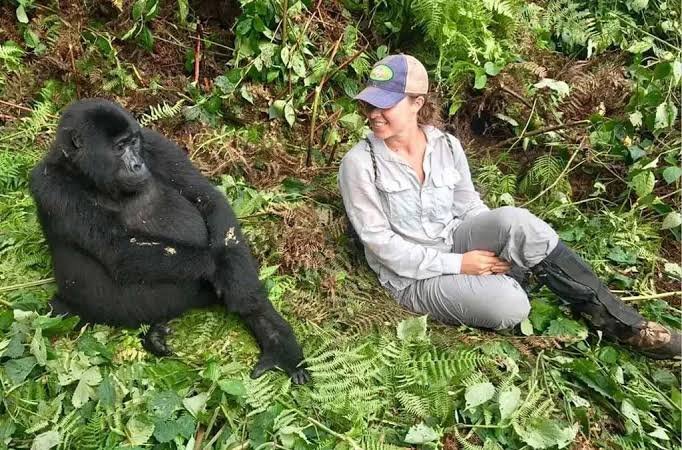
Four Hours With Mountain Gorillas
Join trackers and habituation teams for one of Uganda’s most immersive mountain gorilla experiences.
Where Does the Gorilla Habituation Experience Take Place in Uganda?
The Gorilla Habituation Experience in Uganda takes place in Bwindi Impenetrable National Park, the celebrated rainforest in southwestern Uganda that protects one of the world’s most important populations of mountain gorillas. Uganda Wildlife Authority identifies Bwindi as one of Uganda’s two mountain-gorilla destinations, alongside Mgahinga Gorilla National Park, while the Gorilla Habituation Experience is specifically managed as a specialized conservation and tourism activity involving visitors accompanying researchers and habituators into the forest.
Bwindi Impenetrable National Park is particularly suited to this experience because it has a long history of mountain gorilla research, conservation and tourism. Uganda’s first gorilla family habituated for tourism in Bwindi was the Mubare family, which opened for visitor tracking in 1993. Since then, gorilla tourism has become an important part of the conservation story of the forest and the communities living around it.
For visitors, the location is part of what makes the Gorilla Habituation Experience in Uganda so remarkable. Bwindi is not an open wildlife reserve where animals can be approached by vehicle. It is a dense tropical rainforest characterized by steep hills, tangled vegetation, valleys, streams and thick forest undergrowth. Reaching the gorillas therefore involves trekking on foot through their natural habitat, accompanied by experienced guides, trackers and other authorized personnel.
The exact location of a gorilla family can change from one day to another because mountain gorillas are completely free-ranging wild animals. They move through the forest according to feeding opportunities, weather conditions, social behavior and other natural factors. This means that no two Gorilla Habituation Experiences are exactly the same. Some visitors may locate the gorillas relatively quickly, while on another day the trek may require several hours of walking before contact is made.
Gorilla Habituation in Bwindi Impenetrable National Park
Bwindi Impenetrable National Park is one of Uganda’s premier mountain gorilla conservation areas. Uganda Wildlife Authority currently describes the park as having numerous habituated gorilla groups, although only designated groups are available for tourism or research at a particular time.
The Gorilla Habituation Experience in Bwindi differs from conventional gorilla trekking because visitors are joining an ongoing habituation process rather than simply visiting a gorilla family that has already become fully accustomed to regulated tourist encounters. Uganda Wildlife Authority describes the experience as allowing visitors to accompany researchers and habituators into the forest and participate in the habituation process.
This makes Bwindi much more than the physical location of the activity. The forest becomes an active outdoor classroom where travelers can begin to understand how gorilla conservation works on the ground. Throughout the experience, guides and trackers can explain gorilla behavior, signs used to locate the family, individual identification, conservation challenges and the gradual process through which wild gorillas learn to tolerate carefully managed human presence.
Can You Do Gorilla Habituation in Mgahinga Gorilla National Park?
Uganda offers regular gorilla trekking in both Bwindi Impenetrable National Park and Mgahinga Gorilla National Park. However, travelers should not confuse normal gorilla trekking with the specialized Gorilla Habituation Experience. Uganda Wildlife Authority lists both Bwindi and Mgahinga as gorilla trekking destinations, while its habituation guidelines describe Gorilla Habituation Experience as a separate activity involving researchers and habituators.
Therefore, travelers specifically interested in spending extended time participating in a Gorilla Habituation Experience in Uganda should plan their safari around Bwindi and have their permit and trekking arrangements confirmed before choosing accommodation or finalizing the rest of their itinerary.
At Nextgen Safaris, we arrange the safari according to the location allocated for the Gorilla Habituation Experience, selecting accommodation that minimizes unnecessary driving on the morning of the trek. This is particularly important in Bwindi because the forest covers a mountainous area and access points can be separated by considerable driving distances.
Choosing the correct accommodation and transfer route can make a major difference to the experience. Travelers arriving from Kigali, Entebbe, Queen Elizabeth National Park, Lake Bunyonyi or other destinations should therefore have the habituation location incorporated into the safari planning from the beginning rather than simply booking any lodge advertised as being “near Bwindi.”
For anyone whose main objective is extended time with mountain gorillas, Bwindi Impenetrable National Park is the heart of Uganda’s Gorilla Habituation Experience combining remarkable primate encounters with rainforest trekking, conservation education and the rare opportunity to experience the process behind responsible gorilla tourism.
How Does the Gorilla Habituation Experience in Uganda Work?
The Gorilla Habituation Experience in Uganda is designed to take visitors deeper into the world of mountain gorilla conservation than an ordinary gorilla trek. Instead of visiting a gorilla family that is already fully accustomed to regulated human presence, participants accompany professional trackers, researchers and habituators as they follow a gorilla family that is still undergoing the habituation process. Uganda Wildlife Authority officially describes the experience as an opportunity for visitors to accompany researchers and habituators into the forest while participating in the process of habituating gorillas to human presence.
The experience begins very early in the morning. Under Uganda Wildlife Authority guidelines, the Gorilla Habituation Experience starts from approximately 6:30 am and continues until visitors return to the briefing location for debriefing. This earlier start is one of the first major differences between gorilla habituation and standard gorilla trekking, for which normal tracking officially begins from around 8:00 am.
Travelers should therefore stay close to their designated trekking point the night before the experience. At Nextgen Safaris, we normally arrange accommodation according to the confirmed Gorilla Habituation Experience location so that guests do not have to make an unnecessarily long transfer before sunrise.
Early Morning Briefing Before Entering Bwindi Forest
Your day begins at the designated meeting or briefing point in Bwindi Impenetrable National Park. Visitors receive instructions about the trek, expected forest conditions, appropriate behavior around the gorillas and conservation rules that must be followed throughout the experience.
The briefing is particularly important because the gorilla family being followed is part of an ongoing habituation process. Participants must therefore follow the instructions of the Uganda Wildlife Authority guides, researchers and trackers carefully.
After the briefing, visitors enter the rainforest together with the team responsible for locating and monitoring the gorillas. Unlike a conventional wildlife safari conducted from a vehicle, the entire experience takes place on foot through the dense and mountainous landscape of Bwindi.
Tracking the Gorilla Family Through Bwindi
Finding the gorillas is an important part of the Gorilla Habituation Experience in Uganda. Trackers use their knowledge of the forest and the gorillas’ previous movements to determine where the family may have travelled since it was last observed.
Along the way, they may identify signs such as feeding remains, footprints, broken vegetation, dung and abandoned night nests. For visitors, this makes the journey educational because you begin to understand how experienced trackers interpret signs that most people would walk past without noticing.
The length and difficulty of the search cannot be guaranteed. Mountain gorillas are wild animals moving freely through Bwindi, so they are not found in the same place every morning. One day they may remain relatively close to the previous day’s location, while on another they may have travelled much farther through the forest.
This unpredictability is part of what makes the experience genuine. You are entering the gorillas’ natural environment rather than visiting animals kept within a controlled enclosure.
When Do the Four Hours With the Gorillas Begin?
One of the most important things travelers should understand is the difference between tracking time and viewing time.
Uganda Wildlife Authority defines tracking time as the entire experience beginning after the briefing and continuing until visitors return for debriefing. Viewing time, however, begins when visitors actually reach the gorillas. Under the current UWA guidelines, the Gorilla Habituation Experience allows a maximum viewing period of four hours, compared with a maximum of one hour during normal gorilla trekking.
Therefore, the four hours do not normally include the time spent hiking through the forest looking for the gorilla family. Your total day in Bwindi can be considerably longer once the morning briefing, forest trek, gorilla encounter and return journey are combined.
This distinction is one of the biggest reasons travelers choose the Gorilla Habituation Experience in Uganda. Four hours creates a very different rhythm from a one-hour encounter. There is more time to observe rather than constantly thinking about how quickly the viewing period is passing.
What Happens During the Four Hours With the Gorillas?
Once the gorilla family has been located, the most memorable part of the experience begins. Depending on the family’s movements and behavior that day, you may observe the gorillas feeding, resting, travelling through the vegetation, grooming, communicating, playing or interacting with other members of the family.
A dominant silverback may sit quietly while watching over the group, females may move through the vegetation with their young, and juveniles may climb branches or play close to other family members. At other times, the entire family may begin moving, requiring the team to carefully follow them through the forest.
Because you have a longer observation period, the experience can reveal changes in behavior that would be difficult to appreciate during a shorter visit. A gorilla family can move from feeding to resting and later begin travelling again, giving visitors a broader view of their daily lives.
For photographers, the additional time can also be extremely valuable. Forest photography is challenging because of changing light, vegetation and moving animals. Having more time provides opportunities to wait for clearer views, observe behavior before taking photographs and experience moments without feeling pressured to photograph continuously.
You Are Observing a Family Still Being Habituated
An important difference to remember is that these gorillas are still undergoing habituation. Their reactions to people may therefore differ from those of families that have received tourists regularly for many years.
Habituation is a gradual conservation process. Researchers and habituators repeatedly spend controlled periods around a gorilla family so that the animals slowly become familiar with human presence without changing their natural way of life.
For this reason, the Gorilla Habituation Experience should not be viewed simply as “four hours of normal gorilla trekking.” It is a different type of encounter—one connected more closely to research, monitoring and conservation work.
Visitors are not there to touch, feed or deliberately interact with the gorillas. You are entering their natural habitat as an observer, and every instruction given by the professional team should be respected.
Returning From the Forest
After the permitted encounter has ended, visitors begin trekking back through Bwindi to the designated point. Depending on where the gorillas have moved during the day, the return walk may be shorter or longer than the morning journey.
Uganda Wildlife Authority’s guidelines describe the Gorilla Habituation Experience as continuing until visitors return to the briefing location for debriefing, meaning travelers should keep the entire day available rather than planning another major activity immediately afterward.
Once you emerge from the forest, there is often a tremendous sense of achievement. You have not simply seen mountain gorillas—you have spent a substantial part of the day following them through one of Africa’s most remarkable rainforests and gaining an insight into the conservation process that makes responsible gorilla tourism possible.
This combination of forest adventure, extended gorilla viewing, conservation education and intimate wildlife observation is what makes the Gorilla Habituation Experience in Uganda one of the most exceptional primate experiences available in Africa.
1 Day
1 Day Gorilla Habituation Experience
A concentrated Gorilla Habituation Experience for travelers already staying near Bwindi, giving you the opportunity to enter the forest early and spend extended time observing mountain gorillas.
Book Experience →
2 Days
2 Days Gorilla Habituation Safari
A short Bwindi safari for travelers with limited time, combining transfers with an unforgettable extended mountain gorilla encounter inside Bwindi Impenetrable National Park.
Book Experience →
3 Days
3 Days Gorilla Habituation Experience
A well-paced short gorilla safari allowing time to travel to Bwindi, enjoy a complete Gorilla Habituation Experience and return comfortably after your mountain gorilla adventure.
Book Experience →
4 Days
4 Days Gorilla Habituation & Bwindi Safari
Enjoy a more relaxed stay in southwestern Uganda with additional time around Bwindi, an extended Gorilla Habituation Experience and the spectacular landscapes surrounding the rainforest.
Book Experience → 5 Days
5 Days Gorilla Habituation & Chimpanzee Safari
Combine mountain gorilla habituation in Bwindi with a rewarding chimpanzee tracking experience for a short Uganda journey focused on two of Africa’s most fascinating great apes.
Book Experience →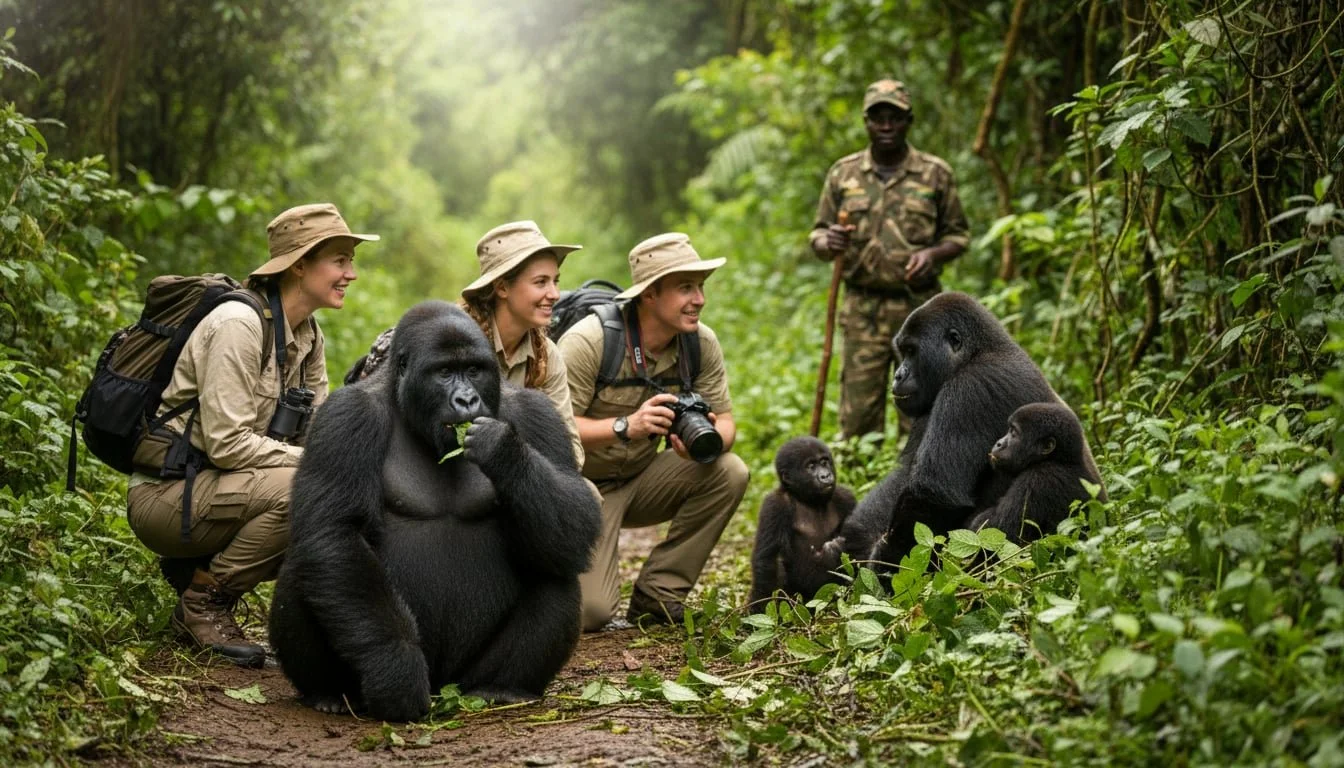 6 Days
6 Days Gorilla Habituation & Primate Safari
Spend more time exploring Uganda’s primate destinations with an immersive Gorilla Habituation Experience in Bwindi combined with additional forest adventures and carefully planned safari transfers.
Book Experience →Gorilla Habituation Experience Permit in Uganda: Cost, Booking and Availability
A Gorilla Habituation Experience permit in Uganda is compulsory for every traveler who wishes to participate in the extended mountain gorilla encounter in Bwindi Impenetrable National Park. The permit is issued through the Uganda Wildlife Authority (UWA) and should be secured before travelers finalize the rest of their safari arrangements. Because Gorilla Habituation Experience spaces are far more limited than ordinary gorilla trekking spaces, confirming permit availability should normally be one of the first steps when planning the trip.
The permit gives the holder access to the designated Gorilla Habituation Experience on a specific date. It covers the official UWA guide fee, park entrance for the day of the activity and a community development contribution. Accommodation, road or air transfers to Bwindi, meals outside arrangements made by your safari operator, personal travel insurance, porter services, tips and other safari activities are separate from the permit itself.
How Much Is a Gorilla Habituation Permit in Uganda in 2026?
| Traveler Category | Gorilla Habituation Permit Price |
|---|---|
| Foreign Non-Residents | US$1,500 per person |
| Foreign Residents | US$1,000 per person |
| Rest of Africa | US$1,000 per person |
| East African Citizens | UGX 750,000 per person |
For travelers planning the experience in 2026, the published UWA Gorilla Habituation Experience tariff has been:
These rates are substantially higher than the standard Uganda gorilla trekking permit because Gorilla Habituation provides a much longer encounter and access to a more specialized conservation experience. UWA’s published tariff lists the Gorilla Habituation Experience at these rates and confirms that the fee incorporates the guide, park entry for the activity day and community development contribution.
Travelers arranging a safari for the latter part of 2026 should nevertheless have the applicable rate reconfirmed when their permit is booked. UWA’s main tariff page currently displays the 2024–2026 tariff alongside its separately announced 2027 tariff changes, making direct confirmation important for any booking falling between published tariff periods. (Uganda Wildlife Authority)
Gorilla Habituation Permit Price From 1 January 2027
Travelers planning a Gorilla Habituation Experience in Uganda in 2027 should pay particular attention to the new permit structure announced by the Uganda Wildlife Authority.
UWA has confirmed that revised Gorilla Habituation Experience prices will take effect on 1 January 2027. The new permit prices are:
| Traveler Category | Gorilla Habituation Permit Price |
|---|---|
| Foreign Non-Residents | US$1,800 per person |
| Foreign Residents | US$1,600 per person |
| Rest of Africa | US$1,000 per person |
| East African Citizens | UGX 750,000 per person |
The increase is especially significant for international travelers. A foreign non-resident Gorilla Habituation permit rises from US$1,500 to US$1,800, while the foreign-resident rate rises to US$1,600. The Rest of Africa rate remains US$1,000 and the East African citizen rate remains UGX 750,000 under the announced 2027 structure.
Travelers comparing safari dates around the end of 2026 and beginning of 2027 should therefore consider the trekking date rather than simply the date on which the safari is booked. The tariff applying to an experience from 1 January 2027 onward will reflect the revised UWA structure.
Gorilla Habituation Permit Price Compared With Normal Gorilla Trekking
The difference in permit price becomes easier to understand when the two experiences are compared. Under the tariff effective from 1 January 2027, a standard Uganda gorilla trekking permit for a foreign non-resident remains US$800, whereas the Gorilla Habituation Experience will cost US$1,800 for a foreign non-resident.
The additional cost is not simply a charge for staying longer in the forest. Gorilla habituation is a specialized experience involving gorilla families that are still becoming accustomed to carefully controlled human presence. Participants spend substantially more time observing the gorillas and experience part of the research and habituation process alongside the professional team.
For someone primarily interested in seeing mountain gorillas once, standard gorilla trekking can provide an exceptional experience at a lower permit cost. However, travelers who are passionate about primates, wildlife photography, behavioral observation or conservation may find the additional investment in Gorilla Habituation Experience in Uganda worthwhile because of the extended encounter.
What Does the Gorilla Habituation Permit Include?
The Uganda Wildlife Authority tariff confirms that gorilla permit rates include the official guide fee, park entrance fees for the day and a community development contribution.
For the Gorilla Habituation Experience, the permit therefore provides access to the regulated activity rather than being a complete safari package.
Your full safari price will normally include additional arrangements such as transportation to and from Bwindi, accommodation, meals, an experienced safari driver-guide and other activities included in your itinerary. At Nextgen Safaris, we can combine the permit with these arrangements so that travelers receive one complete Uganda gorilla safari itinerary rather than having to coordinate every component separately.
This is particularly useful because simply securing a permit does not solve the logistical challenge of reaching the correct part of Bwindi early enough for the activity. Accommodation location, road transfers, border crossings for travelers arriving through Rwanda and the sequencing of other safari destinations all need to correspond with the confirmed habituation date.
How Do You Book a Gorilla Habituation Permit in Uganda?
A Gorilla Habituation Experience permit should be secured for the traveler’s chosen date as early as possible. Before payment, availability needs to be checked for the intended trekking date. Once space is available, the permit can then be secured through the Uganda Wildlife Authority booking system, normally directly or through a licensed Uganda tour operator handling the safari arrangements.
An important booking change took effect on 1 March 2026. Uganda Wildlife Authority suspended the previous seven-day reservation window that had allowed operators to hold permits temporarily without payment. Under the revised system, permits are secured upon full payment at the time of booking, meaning an operator can no longer simply hold a Gorilla Habituation permit for several days while waiting for a client to decide.
This makes early decision-making especially important. When a preferred date is available, travelers should be prepared to confirm the permit rather than assuming the space can be reserved temporarily.
At Nextgen Safaris, we first check Gorilla Habituation Experience availability against your intended travel dates. Once the date is agreed and the required payment is received, the permit can be secured and the rest of the safari—including accommodation and transportation—planned around that confirmed experience.
How Far in Advance Should You Book Gorilla Habituation in Uganda?
There is no single number of months that guarantees availability because demand differs by date and season. However, the limited nature of the experience means that travelers should avoid leaving permit arrangements until the final stages of planning.
For travel during popular safari periods such as June to September, December, Christmas and New Year, booking well in advance is particularly sensible. Travelers with fixed international flights, honeymoon dates, school holidays or other inflexible schedules have even more reason to secure the Gorilla Habituation permit before making the rest of the itinerary too rigid.
The best planning order is generally to establish your approximate Uganda travel dates, check Gorilla Habituation Experience availability, secure the preferred permit and then build the accommodation and safari route around that confirmed date.
Can Nextgen Safaris Book the Gorilla Habituation Permit for You?
Yes. Nextgen Safaris can arrange your Gorilla Habituation Experience permit as part of a complete Uganda safari package. This removes much of the logistical work involved in coordinating the permit with accommodation, transportation and other destinations.
Once you provide your intended travel dates, number of travelers and preferred safari duration, we can check available Gorilla Habituation dates and design the itinerary around the most suitable option. The experience can be arranged as a short 3-day or 4-day Gorilla Habituation safari, or incorporated into a longer Uganda journey combining gorillas with chimpanzees, wildlife game drives, boat safaris and relaxation destinations.
Because Gorilla Habituation permits are date-specific and the booking system now requires payment to secure them, permit confirmation should come before finalizing the rest of the safari. This provides a much stronger foundation for planning the entire Gorilla Habituation Experience in Uganda.
Gorilla Habituation Experience vs Gorilla Trekking in Uganda
One of the most common questions travelers ask when planning a gorilla safari is whether they should choose the Gorilla Habituation Experience in Uganda or normal gorilla trekking. Both experiences offer an extraordinary opportunity to encounter mountain gorillas in their natural forest habitat, but they are quite different in terms of time spent with the gorillas, type of gorilla family visited, overall cost, group size, pace of the experience and the depth of observation. Understanding these differences can help you choose the experience that best matches your expectations, interests and safari budget.
Standard gorilla trekking is the most popular option for first-time visitors to Uganda. Travelers enter the forest with experienced guides and trackers in search of a fully habituated mountain gorilla family. Once the family is located, visitors are normally permitted to spend a maximum of one hour observing the gorillas. That hour can be incredibly rewarding, with opportunities to watch silverbacks, females, juveniles and infants feeding, resting, grooming and moving through the forest.
The Gorilla Habituation Experience in Uganda, on the other hand, provides a much longer encounter. Participants may spend up to four hours with a gorilla family undergoing habituation, making it one of the longest regulated mountain gorilla viewing experiences available to tourists. Rather than simply observing a fully habituated family, visitors gain a closer insight into the gradual process through which wild gorillas become accustomed to controlled human presence.
Four Hours With Gorillas vs One Hour
The most obvious difference between gorilla habituation and ordinary gorilla trekking is the amount of time visitors are allowed to spend in the presence of the gorillas.
During standard gorilla trekking, the maximum viewing period is generally one hour after the gorilla family has been located. For many travelers, that hour is enough to create memories that last a lifetime. However, the experience can pass very quickly, particularly for photographers or visitors who have travelled a long distance specifically to see mountain gorillas.
With the Gorilla Habituation Experience in Uganda, visitors can spend up to four hours around the designated gorilla family once it has been located. This additional time changes the character of the experience significantly. Rather than feeling pressured to capture every moment immediately, travelers can gradually become accustomed to the surroundings and observe the gorillas through different stages of their behavior.
During four hours, a family may feed, move, rest, play, groom and communicate. The dominant silverback may change position several times, mothers may interact with their young, and juveniles may become active after periods of rest. These changing behaviors can provide a much broader understanding of gorilla family life than may be possible within a single hour.
Habituated Gorilla Families vs Gorilla Families Under Habituation
Another major difference concerns the gorilla families themselves.
Standard gorilla trekking takes visitors to families that have already completed the habituation process. These gorillas have experienced controlled human visits over a long period and have gradually become accustomed to the presence of trackers, researchers, guides and small groups of tourists.
During a Gorilla Habituation Experience, visitors join a team working with a family that is still progressing through that process. These gorillas may therefore behave somewhat differently from fully habituated families. They may be more cautious, move more frequently through thick vegetation or maintain greater distance depending on their stage of habituation and behavior on that particular day.
This element of unpredictability is part of the attraction for many travelers. The experience feels less like a conventional tourist encounter and more like joining conservation professionals during their work in the forest.
It is important, however, to understand that habituation does not mean visitors are training, feeding, touching or directly interacting with the gorillas. The process is carefully controlled by trained professionals, and tourists remain observers who must follow established conservation rules.
Gorilla Habituation Offers a Deeper Conservation Experience
For travelers interested in conservation, research and animal behavior, the Gorilla Habituation Experience in Uganda provides considerably more context than an ordinary gorilla trek.
Trackers and habituation teams spend extensive periods monitoring gorilla families, learning their movements, recognizing individual animals and gradually establishing a level of trust that makes regulated tourism possible. Visitors joining the experience get a glimpse into the amount of patience and fieldwork required before a gorilla family can receive ordinary trekking groups.
This can transform the way travelers understand gorilla tourism. Seeing a fully habituated family for one hour is remarkable, but witnessing part of the process that makes those future encounters possible provides a different appreciation of the conservation work happening inside Bwindi.
The experience is therefore particularly attractive to naturalists, wildlife enthusiasts, conservation-minded travelers and anyone interested in understanding gorillas beyond simply seeing them.
Which Experience Is Better for Photography?
For serious wildlife photographers, the Gorilla Habituation Experience in Uganda can offer an important advantage because of the additional time available.
Bwindi is a dense rainforest where photography can be challenging. Light levels can change rapidly, vegetation may partially obstruct the gorillas, and individual animals constantly change their positions. During an ordinary one-hour trek, photographers sometimes have only a limited number of opportunities to capture the exact behavior, expression or composition they are hoping for.
Having up to four hours can provide more opportunities to work with changing light, wait for animals to move into clearer positions and observe behavior before deciding when to photograph.
However, additional time does not guarantee perfect photographs. The gorillas remain wild animals, and the forest environment cannot be controlled. A family may spend part of the encounter in thick vegetation or move through challenging terrain.
For many photographers, that unpredictability is precisely what makes the experience rewarding. Rather than creating staged wildlife photographs, the goal is to capture authentic moments as they naturally unfold.
Which Experience Is More Physically Demanding?
Both gorilla trekking and gorilla habituation require a reasonable level of physical fitness because Bwindi is mountainous and densely forested. Trails may be steep, muddy or slippery, and the distance required to locate a gorilla family varies from day to day.
However, the Gorilla Habituation Experience can potentially involve a longer overall day in the forest. Participants start early, track the gorilla family, spend an extended period with it and then trek back to the starting point.
Travelers should therefore prepare themselves for several hours of forest activity rather than thinking only about the four-hour viewing period.
Fitness should not automatically discourage travelers from choosing habituation. Many people of different ages and fitness levels successfully participate with appropriate preparation. Hiring a porter can also be extremely helpful. Porters can carry backpacks, water, cameras and other equipment while also providing assistance on steep or slippery sections of the trail.
For travelers with particular mobility concerns, it is wise to discuss these with Nextgen Safaris during the planning stage so that the safari can be arranged as appropriately as possible.
Gorilla Habituation Is More Exclusive
The Gorilla Habituation Experience in Uganda is also generally more exclusive than standard gorilla trekking because participation is deliberately limited.
Normal gorilla trekking is available across several gorilla trekking sectors and involves multiple habituated families. This allows a larger number of visitors to participate each day.
Gorilla habituation operates differently. Only designated gorilla families undergoing the habituation process are used for the experience, and visitor numbers are kept very small. This means permit availability can be much more restricted.
The smaller number of participants can make the encounter feel particularly intimate. Instead of being part of a larger tourism flow, visitors spend the day with a small group and the professionals responsible for tracking and habituation.
For honeymooners, photographers, wildlife enthusiasts and travelers seeking something less conventional, this exclusivity can be one of the strongest reasons to select the experience.
Is Gorilla Habituation Worth the Extra Cost?
Whether the Gorilla Habituation Experience in Uganda is worth the additional cost depends largely on what you want from your safari.
If your main goal is simply to see mountain gorillas once and experience the excitement of trekking through Bwindi, standard gorilla trekking provides excellent value and an unforgettable encounter. You still have the opportunity to observe a mountain gorilla family at close range within its natural environment.
If gorillas are the central reason for your journey, however, spending up to four hours with them can justify the additional investment. The experience provides more time for observation, photography, learning and simply appreciating the privilege of being in the forest with these remarkable primates.
For someone travelling to Uganda specifically because of a lifelong fascination with mountain gorillas, one hour may feel surprisingly short. Four hours provides considerably more time to settle into the experience and observe moments that may not occur immediately after locating the family.
Can You Do Both Gorilla Trekking and Gorilla Habituation?
Yes. Travelers who want the most comprehensive gorilla experience can include both ordinary gorilla trekking and Gorilla Habituation Experience in Uganda within the same safari.
This can be an excellent option because the two activities complement each other rather than simply repeating the same experience.
On one day, you might trek a fully habituated gorilla family and enjoy the traditional one-hour encounter. On another day, you can join the Gorilla Habituation Experience and spend much longer with a family that is still progressing through the habituation process.
Doing both allows you to compare the behavior and experience of fully habituated and semi-habituated gorilla families while enjoying two separate journeys through Bwindi Impenetrable Forest.
For dedicated primate enthusiasts and photographers, a safari featuring two gorilla experiences can easily become one of the highlights of an African journey.
At Nextgen Safaris, we can design itineraries that include both activities while allowing sufficient time between trekking days for relaxation and recovery.
Which Gorilla Experience Should You Choose?
Choose standard gorilla trekking if you want an unforgettable mountain gorilla encounter at a lower overall safari cost, have limited time in Uganda or are comfortable with a maximum one-hour viewing experience.
Choose the Gorilla Habituation Experience in Uganda if you want considerably more time with mountain gorillas, are passionate about wildlife photography, want to understand the habituation and conservation process, prefer a smaller and more specialized experience or consider gorillas the main highlight of your trip.
Neither experience should be considered inferior to the other. They are designed for different travelers.
For many first-time visitors, standard gorilla trekking provides everything they hoped to experience. For travelers who want to go deeper, however, Gorilla Habituation offers a level of time, observation and immersion that ordinary gorilla trekking simply cannot provide.
And for those who do not want to choose between them, combining both experiences creates one of the most complete mountain gorilla adventures possible in Uganda.
Best Time for Gorilla Habituation Experience in Uganda
The Gorilla Habituation Experience in Uganda can be done throughout the year, and there is no single month when mountain gorillas suddenly become easier or more rewarding to observe. The gorillas live permanently within Bwindi Impenetrable National Park, meaning visitors can have exceptional encounters during both the wetter and relatively drier periods of the year. The main difference between seasons is therefore not whether gorillas are present, but the condition of the forest trails, rainfall, photography conditions, visitor demand and the overall comfort of trekking.
For most travelers, the best time for Gorilla Habituation Experience in Uganda is during the relatively drier months from June to September and December to February. During these periods, rainfall is generally lower than during Uganda’s main rainy seasons, which can make the steep forest trails easier to navigate. However, Bwindi is a tropical rainforest, so rain can occur at any time of year, including during months normally described as the dry season. Travelers should therefore always prepare for wet conditions regardless of their chosen travel dates.
Bwindi’s mountainous rainforest environment is part of what makes the experience so special. The same moisture that can make trekking challenging supports the dense vegetation, ancient trees, ferns and extraordinary biodiversity that create the mountain gorillas’ habitat. Uganda Wildlife Authority describes Bwindi as an exceptionally important mountain gorilla habitat and one of Uganda’s principal destinations for encountering these primates in their natural environment.
Gorilla Habituation From June to September
June, July, August and September are among the most popular months for travelers planning gorilla safaris in Uganda. June through August generally falls within one of southwestern Uganda’s relatively drier periods, making these months particularly attractive for travelers who want to reduce the likelihood of spending their entire trek in heavy rainfall.
The forest floor may be somewhat firmer during extended periods of lower rainfall, and trails can be easier to negotiate than after several consecutive days of heavy rain. This can be particularly helpful during the Gorilla Habituation Experience because participants may spend a substantial portion of the day walking through Bwindi before, during and after their encounter with the gorilla family.
July and August are especially popular because they coincide with summer holidays in Europe and North America. This means travelers planning a Gorilla Habituation Experience in Uganda during July or August should consider securing their permits and accommodation considerably in advance.
September can also be an excellent month, although rainfall may begin increasing as the region moves toward another wetter period. Travelers should not assume that choosing September guarantees the same trail conditions as the middle of July.
The advantage of travelling during these months extends beyond gorilla habituation. June through September is also an excellent period for combining Bwindi with traditional wildlife destinations such as Queen Elizabeth National Park, Murchison Falls National Park or Lake Mburo National Park, creating a broader Uganda safari around the gorilla experience.
Gorilla Habituation From December to February
The period from December through February is another excellent time for the Gorilla Habituation Experience in Uganda. These months normally fall within Uganda’s shorter relatively dry season and can provide favorable trekking conditions in Bwindi.
December is particularly attractive to travelers combining gorilla habituation with Christmas or New Year holidays. However, festive-season demand can make permits and desirable accommodation highly sought after. Travelers planning around Christmas and New Year should therefore avoid leaving arrangements until the last minute.
January and February can be especially appealing for travelers who want relatively favorable trekking conditions without travelling during the longer June-to-August peak period. The forest remains lush and dramatic, while periods of sunshine can create beautiful light penetrating through the rainforest canopy.
February can also work very well for photographers. Nevertheless, the constantly changing weather of Bwindi means photography conditions remain unpredictable. Bright sunlight can create strong contrasts beneath the canopy, while cloudier conditions often produce softer, more even light around the gorillas.
No month can guarantee perfect photographic conditions, which is another reason the extended viewing period of Gorilla Habituation can be valuable.
Gorilla Habituation During March, April and May
The period from March through May is generally associated with one of Uganda’s main rainy seasons. April is commonly among the wetter months, although rainfall patterns vary from year to year.
This does not mean that travelers should avoid the Gorilla Habituation Experience in Uganda during the rainy season. Gorilla activities continue, and the mountain gorillas remain within their natural habitat throughout the year. For adventurous travelers who are prepared for wet forest conditions, these months can still produce outstanding encounters.
The biggest consideration is the trail.
Rain can transform sections of Bwindi into muddy and slippery terrain. Steep slopes may become more demanding, and trekking boots with good grip become especially important. Lightweight waterproof clothing, gaiters and a quality rain jacket can make a major difference to comfort.
A walking stick can also be valuable when climbing or descending slippery sections, while hiring a porter is strongly recommended. Porters do much more than carry luggage—they can provide a steadying hand through difficult parts of the forest and make the overall trekking experience significantly more comfortable.
One advantage of travelling during wetter months can be a quieter overall safari atmosphere. Uganda receives visitors throughout the year, but some properties and destinations may feel less busy outside the traditional peak travel periods.
The rainforest itself can also be extraordinarily beautiful after rainfall. Leaves become intensely green, mist can settle across the mountains, streams become more active and clouds drifting through the forest create the atmospheric scenery for which Bwindi is famous.
Gorilla Habituation During October and November
October and November are also generally wetter months in southwestern Uganda. Travelers planning a Gorilla Habituation Experience during this period should expect a realistic possibility of rainfall and muddy forest trails.
November in particular can experience considerable rainfall, although weather patterns are never completely predictable.
For photographers and travelers who enjoy dramatic rainforest environments, these months should not automatically be dismissed. Mist, cloud and wet vegetation can create striking photographic conditions, while the forest often appears exceptionally lush.
The key is preparation.
Waterproof hiking boots, long trousers, gardening gloves, a rain jacket, waterproof protection for camera equipment and a small daypack are particularly important. Travelers should also carry sufficient drinking water and a packed lunch because the total experience can occupy much of the day.
Does Rain Stop the Gorilla Habituation Experience?
Light or moderate rainfall does not automatically mean that the Gorilla Habituation Experience in Uganda will be cancelled. Bwindi is a rainforest, and both the gorillas and the teams that monitor them are accustomed to changing weather conditions.
Visitors should therefore arrive mentally and physically prepared for rain rather than expecting completely dry conditions.
A morning may begin with sunshine and turn rainy later in the day, or heavy cloud may clear unexpectedly. Weather conditions can change rapidly because of Bwindi’s mountainous terrain and forest environment.
This unpredictability is part of the authentic rainforest experience.
It is also important to remember that your Gorilla Habituation Experience is not taking place within an artificial wildlife setting where conditions can be controlled. You are following wild mountain gorillas through their natural habitat, and weather is part of that environment.
Is the Dry Season Always Better for Gorilla Habituation?
Not necessarily.
The dry season is often described as the best time for Gorilla Habituation Experience in Uganda primarily because trekking conditions may be more comfortable. Less rainfall can mean less mud, firmer forest trails and somewhat easier hiking.
However, choosing a drier month does not necessarily mean that your actual encounter with the gorillas will be better.
Mountain gorilla behavior is not scheduled around tourist seasons. An extraordinary encounter can happen in April just as easily as in July. Likewise, a traveler visiting during a popular dry-season month may still experience heavy rainfall.
This is why we advise travelers to think about the best time according to their own priorities.
If easier trekking conditions are your main concern, the relatively drier periods may be preferable.
If you are comfortable with rain and prioritize a quieter safari atmosphere, the wetter months can be equally rewarding.
If photography is your main objective, both seasons offer advantages. Dry periods may provide more comfortable equipment handling, while cloudy and misty days can produce wonderfully atmospheric forest photographs.
Best Time for Gorilla Habituation Photography
Wildlife photographers often choose the Gorilla Habituation Experience in Uganda because the extended viewing period provides more opportunities to observe changing behavior and wait for photographic situations to develop.
There is no perfect month for gorilla photography.
Bwindi’s forest canopy creates low-light conditions throughout much of the year. Bright sunshine can penetrate through openings in the canopy and produce patches of strong light and deep shadow. Overcast days can sometimes provide softer and more balanced lighting for photographing dark gorilla fur.
Rain can complicate photography, but it can also create beautiful scenes. Water droplets on gorilla fur, mist behind the animals and lush green vegetation can add tremendous atmosphere to images.
Photographers should therefore focus more on preparation than chasing a supposedly perfect month. Weather protection for camera equipment, spare batteries, sufficient memory cards and appropriate lenses can be more important than the season itself.
Most importantly, photographers should remember that the experience is about observing wild gorillas rather than directing them. The best images often come from patience and allowing natural behavior to unfold.
Best Time for Combining Gorilla Habituation With a Uganda Wildlife Safari
Travelers planning a longer Uganda journey may want to choose their travel period according to the entire safari rather than Gorilla Habituation alone.
A popular itinerary can combine Bwindi with Queen Elizabeth National Park, where travelers can enjoy game drives and a boat safari on the Kazinga Channel before or after travelling to the gorillas. Longer itineraries can continue to Kibale National Park for chimpanzee trekking or north toward Murchison Falls National Park.
June through September and December through February are particularly popular for these combinations because relatively drier conditions can be advantageous for both forest trekking and conventional savannah safari activities.
However, Uganda is genuinely a year-round destination, and the greener months can produce beautiful scenery, excellent birding and a less hurried atmosphere.
Uganda Wildlife Authority notes, for example, that Bwindi and Mgahinga are important birding areas and identifies late May through September as a particularly favorable period for birdwatching, while also noting the influence of seasonal rainfall. (Uganda Wildlife Authority)
For travelers interested in mountain gorillas, chimpanzees, birds, mammals and landscapes rather than only one activity, we can therefore choose the travel month according to the balance of experiences that matters most.
What Is the Best Month for Gorilla Habituation in Uganda?
If you want the simplest recommendation, June, July, August, January and February are among the strongest months to consider for a Gorilla Habituation Experience in Uganda because they generally fall within relatively drier periods and may provide more manageable forest conditions.
But there is an important distinction:
The best weather does not necessarily produce the best gorilla encounter.
A memorable Gorilla Habituation Experience depends on the movements and behavior of the gorilla family, the forest environment and the unique circumstances of that particular day.
For that reason, travelers with flexible dates should certainly consider seasonal conditions, but they should not become overly concerned if their only available travel period falls during a wetter month.
The gorillas are there throughout the year.
At Nextgen Safaris, we can plan the Gorilla Habituation Experience around your preferred travel month and combine it with appropriate accommodation, transportation and additional safari destinations. Whether you travel during the drier months of July and August, the festive period in December, the quieter weeks of February or the lush green season in April and May, Bwindi remains one of Africa’s most extraordinary places to encounter mountain gorillas.
Ultimately, the best time for Gorilla Habituation Experience in Uganda is the time that fits your travel schedule, budget and safari expectations, provided your Gorilla Habituation permit is available for the chosen date.
How Difficult Is the Gorilla Habituation Experience in Uganda?
The Gorilla Habituation Experience in Uganda can be physically demanding, mainly because it takes place inside the mountainous terrain of Bwindi Impenetrable National Park and often requires several hours of walking through dense tropical forest. The difficulty varies considerably from one day to another because mountain gorillas move freely through the forest, meaning there is no fixed trekking distance or guaranteed amount of time required to find them.
Some travelers may locate the gorilla family after a relatively manageable hike, while others may need to walk for several hours across steep slopes, muddy trails, thick vegetation and uneven ground before reaching the group. After locating the gorillas, visitors may spend up to four hours observing them before beginning the return journey. For this reason, travelers should consider the Gorilla Habituation Experience in Uganda as a full-day forest adventure rather than a short wildlife activity.
You do not need to be an athlete to participate, but a reasonable level of fitness, good mobility and some preparation can make the experience much more comfortable and enjoyable.
What Makes Gorilla Habituation Physically Challenging?
Bwindi Impenetrable National Park is not a flat landscape. The forest stretches across steep ridges, valleys and mountainous terrain, with trails that can become slippery or muddy after rainfall. Some sections may involve climbing uphill for extended periods, descending steep slopes or stepping over roots and fallen branches.
The thickness of the vegetation can also make certain sections challenging. Although trackers and guides lead the way, visitors may occasionally move through areas where vegetation is dense and established trails are limited.
Weather can add another layer of difficulty. Bwindi is a tropical rainforest, and rain can occur at any time of year. A trail that feels relatively straightforward when dry can become much more slippery after heavy rainfall.
The Gorilla Habituation Experience can also feel more demanding than standard gorilla trekking because of the extended amount of time spent in the forest. The four-hour gorilla viewing period comes after the family has been located, meaning the total duration of the day can be considerably longer than four hours.
How Long Does the Gorilla Habituation Trek Take?
There is no fixed duration for the entire Gorilla Habituation Experience in Uganda.
The trekking time depends largely on where the gorilla family is located that morning. Mountain gorillas move through the forest according to feeding opportunities, social dynamics and natural daily movements, so their location cannot be predicted with complete accuracy.
The experience begins early in the morning, and visitors should keep the entire day free. The initial search for the gorillas can take anything from a relatively short period to several hours depending on their location.
Once the gorilla family is found, the permitted viewing period can last up to four hours. Visitors must then trek back out of the forest.
This means that your total time in Bwindi may extend well beyond the four hours spent around the gorillas.
Travelers should therefore avoid scheduling another major activity immediately after the Gorilla Habituation Experience. A relaxed evening at the lodge is usually the best way to finish the day.
What Level of Fitness Is Needed for Gorilla Habituation?
A moderate level of fitness is recommended for Gorilla Habituation in Uganda.
You should ideally be comfortable walking for several hours, including uphill and downhill sections. Travelers who regularly walk, hike, exercise or participate in other physical activities usually adapt well to the experience.
However, people who do not exercise regularly should not automatically assume that they cannot participate.
Many travelers prepare successfully by increasing their walking routine several weeks before travelling. Even simple activities such as walking longer distances, climbing stairs and hiking on uneven ground can help improve stamina.
The goal is not to become extremely fit. It is simply to prepare your legs, cardiovascular endurance and balance for a potentially long day in mountainous rainforest terrain.
How Should You Prepare Physically for Gorilla Habituation?
If you are planning a Gorilla Habituation Experience in Uganda, beginning some basic physical preparation before your safari can significantly improve your comfort.
Several weeks before travelling, try to increase the amount of walking you do. Start with manageable distances and gradually increase the length and difficulty of your walks.
Whenever possible, include hills or stairs because these better reflect the type of movement you may experience in Bwindi.
You can also practice walking on uneven ground rather than only using flat roads or treadmills. Forest trekking involves constant changes in footing, so strengthening your ankles and improving balance can be helpful.
Cycling, swimming and other forms of cardiovascular exercise can also improve endurance.
Most importantly, do not exhaust yourself immediately before the trek. The aim is to arrive in Bwindi well rested, hydrated and ready for the adventure.
Should You Hire a Porter for Gorilla Habituation?
Hiring a porter is one of the best decisions many travelers make during the Gorilla Habituation Experience in Uganda.
Porters can carry your backpack, drinking water, packed lunch, camera equipment and other personal items while you concentrate on walking through the forest.
Their assistance can become particularly valuable on steep or slippery sections. A porter can offer a steady hand when climbing, descending or crossing difficult areas, helping reduce fatigue and improving confidence.
Even physically fit travelers can benefit from hiring a porter because carrying additional weight for several hours can become tiring.
Using a porter also contributes directly to local livelihoods around Bwindi. Many porters come from communities surrounding the national park, and the income they earn from tourism provides an important economic benefit connected to gorilla conservation.
For this reason, at Nextgen Safaris, we strongly encourage travelers to consider hiring a porter even if they initially believe they will not need one.
Do You Need a Walking Stick?
A walking stick can be extremely useful during Gorilla Habituation.
It provides additional stability on steep slopes, muddy paths and uneven forest terrain. Walking sticks are particularly helpful when descending because they reduce pressure on the knees and provide an additional point of support.
Depending on the trekking location, walking sticks may be available around the briefing point, but travelers can also bring lightweight trekking poles if they prefer using their own equipment.
Anyone with previous knee, ankle or balance concerns may find a walking stick particularly valuable.
Is Gorilla Habituation Suitable for Older Travelers?
Age alone does not necessarily prevent someone from enjoying the Gorilla Habituation Experience in Uganda.
Many older travelers successfully complete gorilla treks every year. What matters more than age is general mobility, fitness, endurance and personal health.
An active traveler in their sixties or seventies who regularly walks or hikes may find the experience much easier than a younger traveler who rarely exercises.
Older travelers should prepare gradually before the safari and should strongly consider using a porter.
It is also important to travel at a comfortable pace. Gorilla trekking is not a race. Guides understand that visitors have different physical abilities and generally allow appropriate breaks during the trek.
Travelers with existing medical conditions should speak with their healthcare professional before undertaking demanding physical activities at altitude or in mountainous terrain.
What About Travelers With Limited Mobility?
Travelers with limited mobility should discuss their situation carefully before booking the Gorilla Habituation Experience in Uganda.
The extended nature of Gorilla Habituation can make it more demanding than an ordinary gorilla trek, particularly if the gorilla family moves deep into difficult terrain.
In some parts of Uganda’s gorilla tourism system, additional assistance may be available for travelers who need extra support. However, suitability depends on the individual’s mobility, the activity being booked and the conditions of the trekking location.
At Nextgen Safaris, we recommend discussing mobility requirements openly during the planning stage. This allows us to assess the most suitable options and explain realistically what the experience involves before permits and other safari arrangements are confirmed.
Does Altitude Affect Gorilla Habituation?
Bwindi lies within a mountainous region of southwestern Uganda, and some trekking areas are located at relatively high elevations compared with Kampala or Entebbe.
Most travelers do not experience serious altitude problems during a gorilla trek, but some may notice that climbing steep hills feels more tiring than expected.
The best approach is to walk at a comfortable pace, drink sufficient water and avoid trying to keep up with faster participants unnecessarily.
If your safari includes several nights in southwestern Uganda before the Gorilla Habituation Experience, this can also give your body some time to adjust to the environment.
What Happens If the Gorillas Keep Moving?
One important reality of the Gorilla Habituation Experience in Uganda is that the gorillas may continue moving after you locate them.
The experience is not always four hours of sitting quietly in one location.
A gorilla family may feed in one area and later move deeper into the forest. When this happens, the team may need to carefully follow while maintaining the required conservation guidelines.
This can add to the physical demands of the day, particularly when the family moves through thick vegetation or across steep terrain.
However, this movement can also make the experience more interesting because visitors see how mountain gorillas naturally travel through their habitat rather than observing them from a fixed viewpoint.
How Difficult Is Gorilla Habituation Compared With Normal Gorilla Trekking?
In general, Gorilla Habituation can be more demanding than standard gorilla trekking because visitors spend much longer in the forest.
With ordinary gorilla trekking, visitors normally spend a maximum of one hour with the gorilla family once it has been located.
With Gorilla Habituation, the extended viewing period means you may remain in the forest for a significantly longer part of the day.
However, the difficulty still depends greatly on the location of the gorillas. A normal one-hour gorilla trek can sometimes involve a very long and challenging search, while a habituation group may occasionally be located more quickly.
There is therefore no guarantee that one activity will always involve a harder initial trek than the other.
The main difference is endurance: Gorilla Habituation requires visitors to remain active and engaged in the forest for longer.
How Can You Make the Gorilla Habituation Experience Easier?
Good preparation can make a remarkable difference.
Wear sturdy waterproof hiking boots with good ankle support and strong grip. Carry a lightweight waterproof jacket and wear long trousers to protect your legs from vegetation and insects.
Use a porter to carry unnecessary weight and consider using a walking stick for additional stability.
Bring enough drinking water and your packed lunch, but avoid carrying an excessively heavy backpack.
Most importantly, listen to your guide and walk at a pace you can maintain comfortably throughout the day.
There is no reward for reaching the gorillas first.
The purpose of the Gorilla Habituation Experience in Uganda is to enjoy the journey through Bwindi and appreciate the extraordinary privilege of spending extended time with mountain gorillas in their natural habitat.
For travelers with reasonable fitness and proper preparation, the physical challenge often becomes part of what makes the experience so rewarding. Walking out of Bwindi after several hours in the rainforest brings not only extraordinary memories of the gorillas but also a powerful sense of accomplishment.
What to Wear and Pack for the Gorilla Habituation Experience in Uganda
Knowing what to wear and pack for the Gorilla Habituation Experience in Uganda can make a major difference to your comfort in Bwindi Impenetrable National Park. The forest is humid, mountainous and often wet, with thick vegetation, muddy trails, insects and rapidly changing weather. Because the experience can occupy much of the day, travelers should prepare for both physical activity and unpredictable rainforest conditions.
The most important principle is to dress for the forest rather than for a conventional safari. Lightweight but protective clothing, strong hiking footwear and waterproof layers are much more useful than heavy fashion-oriented safari clothing. What you carry should also be practical, because an unnecessarily heavy backpack can become uncomfortable after several hours of trekking.
Wear Strong Waterproof Hiking Boots
A good pair of waterproof hiking boots is one of the most important items for the Gorilla Habituation Experience in Uganda.
Bwindi trails can be steep, uneven and muddy, especially after rainfall. Shoes with strong grip and ankle support provide better stability than ordinary trainers or casual walking shoes.
Waterproof footwear is particularly useful because even during relatively dry months, sections of the forest may remain damp. Small streams, wet vegetation and muddy ground are common features of the trekking environment.
Travelers should avoid wearing completely new boots for the first time on trekking day. It is much better to break them in before travelling so that you know they fit comfortably and do not cause blisters.
Wear Long Trousers
Long trousers are strongly recommended for Gorilla Habituation.
They protect the legs from branches, nettles, insects, mud and dense vegetation. Lightweight hiking trousers are usually a better option than thick jeans because they dry faster and allow easier movement.
Some travelers choose to tuck their trousers into their socks to reduce the chance of insects reaching the skin.
The main objective is protection and comfort rather than appearance.
Wear a Long-Sleeved Shirt
A lightweight long-sleeved shirt or breathable trekking top can protect your arms from vegetation, insects and scratches.
The forest can feel warm and humid while you are climbing, so breathable material is particularly useful.
Layering works well in Bwindi because temperatures can feel cool early in the morning and warmer once you start walking. A lighter base layer with a long-sleeved outer layer allows you to adjust according to the weather.
Carry a Lightweight Waterproof Rain Jacket
A waterproof rain jacket is essential, even if you are trekking during Uganda’s relatively dry season.
Bwindi is a tropical rainforest, and rain can develop with little warning. A clear morning does not guarantee a dry afternoon.
Choose a lightweight jacket that can be packed easily into your backpack when not needed. Ideally, it should protect you from rain without becoming excessively hot during physical activity.
Heavy winter-style waterproof jackets are normally unnecessary because the main challenge is rainfall rather than extreme cold.
Gardening Gloves Can Be Surprisingly Useful
Many travelers are surprised to see gardening gloves recommended for gorilla trekking, but they can be extremely practical.
During steep climbs or descents, you may occasionally use vegetation for balance. Gloves protect your hands from rough branches, thorns, nettles and mud.
They are particularly helpful in wet conditions when the ground becomes slippery and you need additional support.
Lightweight gardening or trekking gloves are sufficient.
Bring a Small Comfortable Daypack
A small waterproof or water-resistant daypack is ideal for carrying your essentials.
You may need space for drinking water, packed lunch, rain gear, camera equipment, spare batteries, sunscreen and personal medication.
Avoid carrying an oversized backpack. Remember that anything you carry into the forest may remain on your back for several hours unless you hire a porter.
At Nextgen Safaris, we strongly recommend using a porter so you can concentrate on the trek rather than carrying unnecessary weight.
Carry Enough Drinking Water
The Gorilla Habituation Experience in Uganda can be a long and physically demanding day, so proper hydration is important.
Carry sufficient drinking water from the beginning of the trek. Your lodge or safari team can usually help ensure you have enough water before departure.
Drink regularly rather than waiting until you feel exhausted or dehydrated.
A reusable water bottle is a good option where practical.
Take a Packed Lunch and Energy Snacks
Because the experience can last for several hours, travelers should carry a packed lunch.
Your accommodation will normally prepare this before you leave in the morning. Depending on your trek, you may eat lunch in the forest during an appropriate break.
Small energy snacks can also be useful, particularly if you are hiking for an extended period.
Choose simple foods that are easy to carry and do not create excessive packaging.
Protect Your Camera Equipment From Rain
For photographers, waterproof protection is extremely important.
Bwindi’s weather can change quickly, and moisture can damage cameras, lenses and other electronic equipment.
Carry a waterproof camera cover or dry bag and keep spare batteries and memory cards protected inside sealed compartments.
Even if it does not rain heavily, humidity and wet vegetation can still expose equipment to moisture.
The extended time available during the Gorilla Habituation Experience makes it attractive to photographers, but being prepared for rainforest conditions is essential.
Avoid Flash Photography
Flash photography should not be used around mountain gorillas.
Travelers should therefore understand their camera settings before entering the forest, particularly if they are using a professional or semi-professional camera.
Bwindi can be relatively dark beneath the forest canopy, so photographers should be comfortable adjusting ISO, shutter speed and aperture without relying on flash.
Those using smartphones can still take excellent photographs, especially when the gorillas are in open vegetation or softer natural light.
Bring Spare Batteries and Memory Cards
The four-hour viewing opportunity may encourage you to take considerably more photographs and video than during a standard one-hour gorilla trek.
Bring at least one spare battery for your camera and sufficient memory-card capacity.
Cold mornings, video recording and continuous photography can drain batteries faster than expected.
Power banks can also be useful for smartphones, although they should be packed securely and protected from moisture.
Carry Insect Repellent
Bwindi is a tropical forest, so insect repellent can be useful.
Apply it before beginning the trek and carry a small amount for reapplication if necessary.
Long trousers and long sleeves also reduce exposed skin and provide additional protection.
Travelers should follow any medical advice they have received regarding malaria prevention and other health precautions before visiting Uganda.
Sunscreen Is Still Useful in the Forest
Although much of the trek takes place under the forest canopy, there may be exposed areas before entering the forest or along certain sections of the trail.
Carrying a small amount of sunscreen can therefore still be useful.
A hat can also provide protection during open sections and while waiting around briefing areas.
Carry Personal Medication
If you take prescription medication or may need basic personal medicine during the day, carry it in your daypack.
Do not leave essential medication at the lodge because you may be in the forest for many hours.
Travelers with allergies or specific medical needs should also inform their guide or safari leader where appropriate.
Consider Gaiters
Gaiters are not compulsory, but they can be very useful during wet or muddy conditions.
They protect the lower part of your trousers and help prevent mud, water and small insects from entering your boots.
Travelers trekking during wetter months may find them particularly worthwhile.
Do Not Overpack
One of the biggest mistakes travelers make is carrying too much.
For the Gorilla Habituation Experience in Uganda, focus on essentials: water, lunch, rain protection, camera equipment, personal medication and a few small personal items.
Leave unnecessary electronics, heavy clothing and valuables at your lodge.
The lighter your load, the easier it will be to move through Bwindi’s steep terrain.
Essential Gorilla Habituation Packing Checklist
For a comfortable day in Bwindi, travelers should ideally have strong waterproof hiking boots, long trousers, a long-sleeved shirt, a lightweight rain jacket, gloves, a small daypack, sufficient water, packed lunch, insect repellent, sunscreen, personal medication and waterproof protection for cameras and electronics.
A walking stick and porter can also make a significant difference, especially on steep or slippery sections.
Good preparation will not remove every challenge from the forest, but it can make the Gorilla Habituation Experience in Uganda much more comfortable, safer and more enjoyable.
When you are properly equipped, you can focus less on the mud, weather and terrain and more on the extraordinary reason you came to Bwindi in the first place: spending extended time in the presence of wild mountain gorillas.
Who Can Do the Gorilla Habituation Experience in Uganda?
The Gorilla Habituation Experience in Uganda is available to travelers who meet the Uganda Wildlife Authority’s age requirements and are physically capable of undertaking a potentially long trek through Bwindi Impenetrable National Park. While the experience attracts everyone from wildlife photographers and honeymooners to solo travelers and older adventure seekers, there are important rules concerning age, health, physical ability and behavior around the mountain gorillas.
Unlike a conventional game drive where most wildlife viewing takes place from inside a safari vehicle, gorilla habituation requires participants to enter the rainforest on foot and follow the movements of a wild gorilla family. Travelers should therefore understand the requirements before purchasing a permit.
What Is the Minimum Age for Gorilla Habituation in Uganda?
The minimum age for tracking and viewing mountain gorillas in Uganda is 15 years under Uganda Wildlife Authority guidelines. This age requirement applies to Uganda’s regulated gorilla experiences, including the Gorilla Habituation Experience.
This means that a traveler should be 15 years old or older on the date of the gorilla experience.
The age restriction is important because Gorilla Habituation is not simply a sightseeing excursion. Participants may spend many hours in the forest, encounter steep and slippery terrain and must be able to understand and follow instructions from guides and conservation personnel throughout the encounter.
The experience also requires calm behavior around a gorilla family that is still undergoing habituation. Participants need to understand that sudden movements, unnecessary noise and failure to follow instructions can interfere with the carefully managed encounter.
Families travelling with younger children should therefore plan alternative activities for them while eligible family members undertake Gorilla Habituation. Depending on the overall Uganda itinerary, parents can combine gorilla activities with family-friendly experiences in other destinations rather than designing the entire safari around an activity younger children cannot participate in.
At Nextgen Safaris, we can arrange a family itinerary so that parents or older children eligible for the Gorilla Habituation Experience can participate while suitable arrangements are made for younger members of the family.
Is Gorilla Habituation Suitable for First-Time Gorilla Visitors?
Yes. You do not need previous gorilla trekking experience to participate in the Gorilla Habituation Experience in Uganda.
Some travelers assume that they should complete an ordinary gorilla trek before attempting habituation, but this is not a requirement. A first-time visitor can choose Gorilla Habituation as their first mountain gorilla encounter provided they meet the age requirement and are comfortable with the physical demands.
In fact, travelers whose main reason for visiting Uganda is mountain gorillas may prefer to begin with the more immersive experience.
The guides, trackers, researchers and habituators accompanying the activity provide instructions before and during the trek, so visitors are not expected to arrive with scientific knowledge of gorillas.
What matters most is being prepared to listen, remain patient and respect the instructions given by the professional team.
Is Gorilla Habituation Suitable for Solo Travelers?
The Gorilla Habituation Experience in Uganda is an excellent option for solo travelers.
You do not need to travel with your own private group in order to purchase a permit. Eligible travelers with confirmed permits can participate according to the allocation and arrangements made for that particular date.
For a solo traveler, this can be one of the easiest ways to enjoy an exceptionally meaningful wildlife experience without requiring travel companions.
A complete solo Gorilla Habituation safari can be arranged from Entebbe, Kampala or Kigali, with private transportation and accommodation while the actual forest experience is conducted according to UWA’s regulated arrangements.
Solo photographers can find Gorilla Habituation particularly appealing because of the extended viewing opportunity. Instead of travelling all the way to Uganda for only a short encounter, they have the potential for up to four hours of observation once the gorilla family has been reached.
Is Gorilla Habituation Good for Couples and Honeymooners?
For adventurous couples, the Gorilla Habituation Experience in Uganda can become one of the defining moments of a honeymoon or private African safari.
It is particularly suitable for couples who prefer meaningful experiences over conventional luxury alone. Spending a morning trekking through Bwindi before encountering mountain gorillas offers something completely different from a traditional beach honeymoon or vehicle-based safari.
The experience can also be combined with romantic accommodation around Bwindi, scenic drives through Uganda’s southwestern highlands, relaxation at Lake Bunyonyi or a longer luxury safari through Queen Elizabeth National Park and Kibale National Park.
Couples should remember, however, that Gorilla Habituation remains a genuine wilderness activity. Mud, rainfall, steep terrain and physical effort are part of the experience.
For many adventurous honeymooners, that is precisely what makes it memorable.
Is Gorilla Habituation Suitable for Older Travelers?
There is no general upper-age limit stated in the UWA minimum-age guideline. What matters practically is whether a traveler can cope with the physical demands of the forest and safely participate in the activity. UWA specifies a minimum age of 15 years for gorilla tracking and viewing.
Many active travelers in their sixties and seventies successfully undertake gorilla experiences in Uganda.
Physical ability varies enormously between individuals, so age alone is not a reliable measure of whether someone will enjoy the trek. A traveler who regularly walks and exercises may be very comfortable in Bwindi, while someone much younger but inactive may find the hills challenging.
Older travelers should consider hiring a porter, using a walking stick and preparing physically before the safari.
It is also important to be realistic when choosing between standard gorilla trekking and Gorilla Habituation. Because habituation can involve significantly more time in the forest, travelers concerned about stamina may prefer the shorter viewing format of normal gorilla trekking.
Do You Need to Be Very Fit?
You do not need to be an athlete, but participants should have a reasonable level of mobility and endurance.
The Gorilla Habituation Experience begins early, from around 6:30 am under UWA’s published guidelines, and continues until participants eventually return to the briefing point. Once the gorilla family is reached, the designated maximum viewing time is four hours.
This means the entire activity may require a substantial portion of the day.
Your actual difficulty depends largely on where the gorillas have moved. Mountain gorillas are not kept in one predictable location for tourists. Their movements determine how far trackers and visitors must travel through the forest.
Travelers should therefore be capable of walking over uneven terrain for several hours and should prepare for hills, mud and vegetation.
Health Considerations Before Gorilla Habituation
Health is particularly important when visiting mountain gorillas.
Gorillas are genetically close to humans and can be vulnerable to human-borne pathogens. Research on the Virunga mountain gorilla population has documented the conservation concern surrounding transmission of human diseases to mountain gorillas, including respiratory infections. (Uganda Wildlife Authority)
This is one reason gorilla tourism is carefully regulated rather than allowing unrestricted contact between visitors and the animals.
Uganda Wildlife Authority also maintains distance and other protective procedures intended to reduce close contact between humans and gorillas. (Uganda Wildlife Authority)
Visitors should therefore take health instructions seriously. If you become unwell before your scheduled Gorilla Habituation Experience, inform your safari operator or the responsible park personnel rather than attempting to hide symptoms.
Protecting the gorillas is more important than obtaining photographs or completing an individual trek.
Why Health Rules Matter Even More During Gorilla Habituation
Health precautions are especially relevant to the Gorilla Habituation Experience in Uganda because visitors can potentially remain around the gorilla family for much longer than during standard trekking.
Normal gorilla tracking allows a maximum of one hour of viewing, while the Gorilla Habituation Experience permits a maximum of four hours once the gorillas have been encountered.
Longer exposure makes responsible behavior particularly important.
Travelers should therefore regard all instructions concerning distance, hygiene and behavior as conservation measures rather than inconveniences.
The privilege of spending several hours around wild mountain gorillas exists only because tourism is tightly controlled to minimize disturbance and protect the animals.
Can Pregnant Travelers Do Gorilla Habituation?
Pregnancy does not automatically determine whether someone can comfortably undertake a forest activity, but the Gorilla Habituation Experience can involve strenuous walking, steep slopes, mud, slippery terrain and several hours away from immediate road access.
A pregnant traveler considering the experience should therefore obtain individualized advice from their healthcare professional before booking.
It is particularly important to consider the stage of pregnancy, personal fitness, previous hiking experience and the unpredictable nature of the trek.
Nextgen Safaris should also be informed of any mobility or logistical considerations that may affect safari planning, while personal medical decisions remain between the traveler and their healthcare professional.
Is Gorilla Habituation Suitable for Travelers With Mobility Challenges?
Travelers with significant mobility limitations should discuss their requirements before purchasing a Gorilla Habituation permit.
Bwindi’s terrain can be demanding, and Gorilla Habituation has the additional challenge of an extended period in the forest.
Assistance from porters can make the trek considerably easier for many travelers, but a porter cannot eliminate every difficulty associated with mountainous rainforest terrain.
The best approach is to discuss individual circumstances during the planning stage rather than purchasing a permit first and addressing mobility issues afterward.
At Nextgen Safaris, understanding a guest’s mobility requirements before confirming the itinerary allows us to provide more realistic advice and structure the overall safari appropriately.
Can Wildlife Photographers Participate?
Absolutely. Wildlife photographers are among the travelers who may gain the greatest value from the Gorilla Habituation Experience in Uganda.
UWA defines Gorilla Habituation as an experience in which visitors accompany researchers and habituators into the forest as part of the habituation process. The longer permitted viewing period can give photographers time to observe changing behavior rather than rushing to capture everything immediately.
However, photography never overrides the conservation rules.
A photographer must follow the same instructions as every other visitor and cannot approach a gorilla simply to obtain a better angle.
The gorillas determine the encounter—not the camera.
Who Is Gorilla Habituation Best For?
The Gorilla Habituation Experience in Uganda is especially rewarding for travelers who want more than a quick wildlife sighting.
It is ideal for gorilla enthusiasts, wildlife photographers, conservation-minded travelers, researchers at heart, adventurous couples, solo travelers and returning gorilla trekkers who want a deeper encounter.
It can also be an excellent choice for someone undertaking a once-in-a-lifetime journey to Uganda and who wants mountain gorillas to be the central experience of the safari.
Travelers with very limited time, a lower safari budget or concerns about spending an extended day in difficult terrain may prefer standard gorilla trekking.
Neither choice is wrong.
The important thing is selecting the experience that matches your physical ability, expectations and interests.
For travelers aged 15 years and above who are prepared for the forest and willing to respect the conservation rules, the Gorilla Habituation Experience offers an extraordinary opportunity to enter Bwindi not merely as a spectator, but as a visitor witnessing part of the careful process through which humans learn to observe mountain gorillas responsibly.
Ready for the Gorilla Habituation Experience in Uganda?
Let us plan your Gorilla Habituation Experience in Bwindi Impenetrable National Park, including permits, accommodation, private transfers and a safari itinerary designed around your travel dates.
Book Your Experience →